Your AI Access Can Disappear Overnight: Build an Open-Source Backup Plan
· 4 min read · Emmett Lawlor
A government order switched off access to two AI models overnight
Yesterday, an export-control directive from the US government forced Anthropic to suspend access to two of its most capable models, Fable 5 and Mythos 5, for every customer everywhere, including Anthropic's own international staff. The government cited national security concerns over a jailbreak method. The suspension took effect within hours, compared to the months of warning a price hike or a deprecation notice usually gives you.
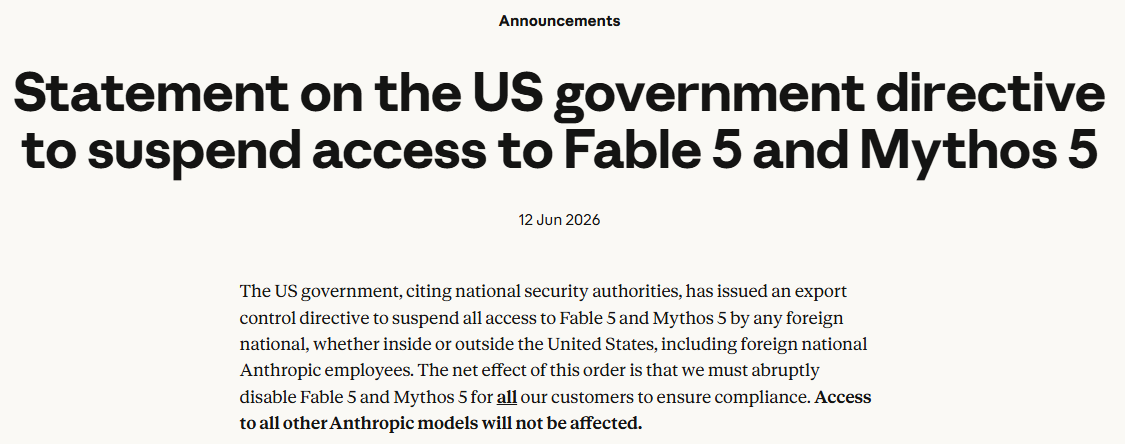
If your product or your business depends on a commercial AI model, this matters to you. It doesn't matter how big the company is or how much you've paid them. A third party can switch off your access for reasons that have nothing to do with you, and it can happen faster than you can renegotiate the contract.
Every commercial AI customer has the same exposure
You could read this story and file it under "interesting AI news" and move on. But strip away the company and model names, and a fact about commercial AI access remains: it's a privilege granted to you. You don't own it.
That sits oddly next to the current mood in the AI industry: IPO speculation and valuations that assume access like this is durable and only growing. You got a reminder yesterday that the legal and political ground these companies operate on can shift overnight, and customers feel it first. No migration window. No SLA clause that covers "a government told us to."
An open question we're watching
This particular directive doesn't mention the space industry. We're curious how AI access policy will intersect with other sectors that sit close to national security, with aerospace and the US space industry as an obvious example. We don't have anything concrete to say about it yet, but we're watching.
Why open-source models are different
Open-weight models are the alternative. You download them once and run them yourself, on your own hardware, indefinitely.
Once an open-source model sits on your hardware, whether that's your laptop or your own server, nobody can revoke it. No government directive or policy change can reach into your machine and take it away. You own a copy of it, permanently.
Open-source models aren't always the best tool for the job. Commercial models often lead on raw capability. But for the parts of your stack where continuity matters, open source is the option nobody can revoke.
Open-source models have gotten good, and the tooling to run them has gotten easy. Below is where to start.
Where to start: open-source AI tools you can run yourself
Large language models
- Ollama: the easiest way to run open LLMs on your own machine. It exposes a local, OpenAI-compatible API, so if you've already built something against OpenAI's API format, pointing it at Ollama instead is often a drop-in change.
- Hugging Face Models: the largest catalogue of open models, filterable by what they do: text generation, image generation, video generation, and more. If you want to know what's out there, this is the place to look.
Image and video generation
- FLUX.1: a strong open-weight image generation model, supported by local generation tools and available via Hugging Face.
- Wan2.2: an open video generation model worth a look if you're experimenting with AI-generated video.
Text-to-speech
- Supertonic: a free, on-device text-to-speech engine. No API key, no dependency on a remote service staying online.
- MOSS-TTS: open TTS geared towards sound effects, useful if you're building anything with audio beyond plain narration.
Agents
- Hermes Agent: an open agent framework that improves as you use it, instead of staying frozen at whatever capability it shipped with.
The takeaway
Don't rip out your AI stack and self-host everything tomorrow. But when you're deciding what to build on, treat durability as a feature. A model you download and run on your own terms has a kind of value that mere access to someone else's model, however good it is today, can't match.
This is the thinking we bring to the software we build for clients: don't bet the parts of your business that matter on infrastructure you don't control. If you're exploring where AI fits into your product or your day-to-day operations, and you want a setup that's still working the day after a headline like yesterday's, get in touch. We're happy to talk through what that could look like for you.